Simon's Chart
Tags: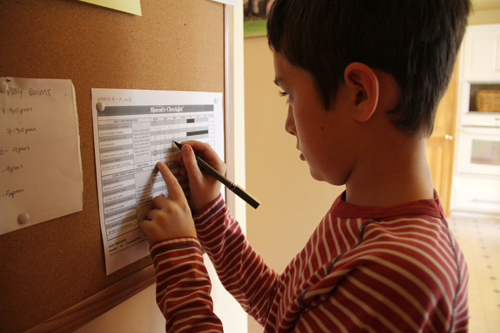
Two weeks ago Chris initiated the creation of a new chart for Simon.
I'm pretty sure the catalyst was a conversation we had while sitting in the driveway after visiting a middle school for Simon (that whole process is another story for another day). We were talking about structure, attitude, hopes & dreams, fears & frustrations, screen time, etc. The chart idea was originally brought up by a psychologist that we (and Simon) met with last summer - he encouraged a similar chart to establish a set of norms and rewards. We worked with it for a bit and then got distracted.
Basically, we let it go. And things were okay.
Fast forward to today and I'm thankful to Chris and Tiffany for taking the time to create and get a new chart going. This one is more specific than the previous one and deals more directly and concretely with screen time as a reward. The other chart had rewards like legos, pool time, new books, etc - all things he likes of course but not really as motivating or immediate.
The goal of this chart is specifically to create structure around screen time. Screen time (tv, computer, video games) is a big topic around here as Simon's definitely a fan of tv, movies and computer/video games. There's definitely a secondary benefit around teaching responsibility, respect, sharing of household duties, establishing clear expectations and routine (which we know he loves already).
The chart looks like this:
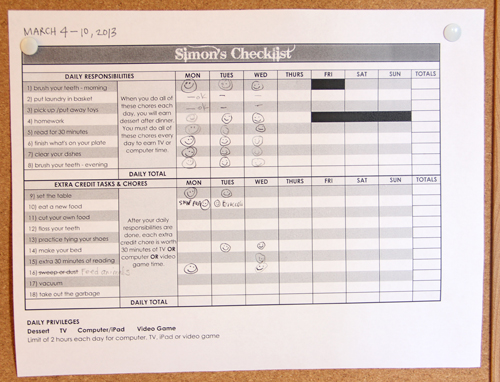
Keep in mind when looking at the chart that these tasks are very specific to Simon. Some are more relevant to Chris' house than my house and I'll be adjusting some of the tasks to reflect what needs to be worked on at my house (like feeding the animals).Anna's going to get a chart too and her responsibilities and extra credit tasks will be different from Simon's.
The chart includes a list of daily responsibilities that are simply non-negotiable things he needs to do each day. He needs to do them to even "qualify" to earn screen time. Some of these things he does daily already without complaint and others are a daily struggle.
The second list includes the ways he can earn screen time (with a max of two hours per day).
What we've learned in the last week and a half is that he's really motivated to earn screen time (feel like I should write "duh" here).
What I've noticed in just a week of using the chart is that he seems more present, more in tune, and more willing to do daily tasks without complaint. He's also eating non-preferred foods with less complaining (he's been doing much better in general with trying new foods, but it's still a big part of our daily dialogue and is anxiety inducing for him).
Last night he ate steak, roasted Brussels sprouts and peaches with minimal complaints. He fed the animals without me even asking him first - he saw the clock said 5pm and he knew it was time for them to eat. When he completes a task he goes over to the chart and puts a smiley face in the appropriate box.
I definitely still need to monitor the time he actually spends in front of a screen but this process has given us something concrete to turn to - something he understands because he can see it, read it and comprehend what needs to be done to earn time.
The lessons for me? Keep trying. Don't give up. Ask for help. Documentation and visual lists are great for Simon (again, not something new to me but I needed the reminder and, humbly, for someone to take the initiative and make it happen).
Go Simon, go.
EDITED |You can download the Excel version of this chart for customization here.
Comments
Sign in or sign up to comment.
91 comments
Great chart and great idea! Do you mind sharing the template? Great job Simon!
Replies
Hi Amy! I edited the post to include the Excel spreadsheet as a download (link located at the end of the post).
Sign in or sign up to reply.
Wow, awesome! Keep up the good work Simon!!
Replies
Sign in or sign up to reply.
This is a great thing. So glad Simon is actually doing it and enjoying it.
Replies
Sign in or sign up to reply.
Oh, yeah! Good for you and Simon and I hope that things keep working. We are a very informal family and though we've tried systems like this, it is very hard to keep it up. I know how important it can be for kids, especially those that need concrete, visual devices, to help them focus on what WE want them to focus on, but having to kind of make it up as we go makes it difficult since everyone in the world is so different (and we kind of tend to celebrate that at our house!) Thanks for sharing!
Replies
Sign in or sign up to reply.
oh ali, thank you for sharing this. my boys are highly incentivized by technology. we've been using a marble jar for 1st time listening, but i LOVE the idea of the boys checking off on their list of things they must do as part of the family and extra credit. will be using that idea. thank you. and hurray for simon!!!
Replies
Sign in or sign up to reply.
GREAT IDEA... We also strugle with our ASD kid. Love that you have incorpoated "food" too.. always a struggle for them. The whole middle school thing is a big adjustment, we have been struggling with for sometime (7th grader). We get through it. So great the Simon is so open to the chart idea. He is such a great kid.
Replies
Sign in or sign up to reply.
I love the idea of charts, and I've tried tirelessly for months now to get my kids on some kind of reward schedule like that. The problem I have is that by the time we get home at the end of the day (from school & work), there's only really a good 2 or 3 hours left before bedtime. So if they don't complete a task and don't earn our house's equivilent of "screen time", it's a bummer but they don't REALLY care because it's pretty much bedtime anyways so what's the point. I tried to keep at it, with the hope that even if they didn't do ANY tasks for 4 days, eventually they will want the screen time and they will do what needs to be done. But I don't like that because I don't feel like it's teaching them enough responsibility. So I am at a loss and feel like giving up. I feel like if I give up, at least we won't be fighting. :(
Replies
Sign in or sign up to reply.
Ali, your "Lessons Learned" on this one went right to my heart - "keep trying and don't give up"! I've been where you are and can now look back and tell you that every last chart, reward, technique, etc (whether is seemed a success or failure at the time ) was oh so worth it! My special ASD guy is now creating a life, on his own, that I can hardly believe. So keep at it - Simon will amaze you!
Replies
Sign in or sign up to reply.
I love this. My son was diagnosed with a ASD this past fall and usually responds well with a visual schedule at school, but I love how the rewards are outlined on yours. I am forever saying; "first we so this, then we can do that". I am excited for my little guy to learn to read in order to use a more specific one like yours. So awesome! Go Simon!!!
Replies
Jen,
Your child doesn't have to be able to read to implement something similar (age appropriate of course). When my youngest was little and we had a chart for the older siblings he wanted one as well so I made one completely with stickers. You may even find icons on line for the tasks, drop those in so he understands his chores and then have a sheet of smiley faces or frowns for him to place when completed or not. They love to even place the stickers on there and the rewards can also be pictures.
My youngest loved it and felt so grown up for participating. Today, at 17 he is my most motivated and self regulated kid, I think because I started so young with him purely by accident.
Good luck and never give up, be creative.
"First this, then this" is something we've been using for years. I remember hearing his early education teachers using that so clearly - it's a great teaching/reinforcement tool.
Sign in or sign up to reply.
So glad it's working for him! We established a similar chart for our older kids (ages 7 and 8) but their reward is money. They don't care much about electronics (we're not a big techy family) but are always asking to earn money to buy things. We didn't feel it was right to simply give them money, and we didn't want them to earn money for chores they need to do anyway, because doing chores is part of being a family. So we made a chart with daily chores they must do regardless, and then another chart of extra chores they can do to earn money. They can only earn money for extra chores if they've done all their normal chores first. Each extra chore has a monetary value attached to it, and I keep a list of money they've earned that day on our family calender. They only get paid once a week, because that's how the real world works and we want them to learn that. It's worked really well for us. :)
Replies
Love that Shaele. Great example that this sort of system can be used for whatever the highest reward is at a given time.
Sign in or sign up to reply.
I have a 10-year-old son and my fight now is the same that her of you: the responsibility. It has a list of tasks that to fulfill of that it has to take charge without an adult remembers it and is ... it is ... I suppose that it is a question of patience. Reading his post I have felt totally identified in the task that this you realizing and I him want to send many spirits, nobody said to us the difficult thing that is to educate but to be for them and to cost a sorrow.
A greeting,
Conchin
Replies
Sign in or sign up to reply.
Great one. Would a template be available by chance? Thanks.
Replies
THANKS MUCH.
Hi Shelley! I edited the post to include the Excel spreadsheet as a download (link located at the end of the post).
Sign in or sign up to reply.
first of all, LOVE this!!! Do you by anychance have a pdf you'd be willing to share? Thanks!
Replies
Thank you!
Hi Samantha - I don't have a PDF but I did add a download to the post for the Excel spreadsheet which makes it able to be customized.
Sign in or sign up to reply.
Thank you, thank you, thank you!! My son's OT recently recommended a responsibility/timeline chart for him as well and I was having trouble coming up with a format. This is perfect. LOVE that it includes the 'extra credit' for extra screen time. He's also HIGHLY motivated by anything electronic and we've been struggling with how to limit it 'fairly'.
Replies
Sign in or sign up to reply.
I wish I'd done something like this years ago. I am now trying hard with my sweet 15 yr old who has ASD/anxiety to incorporate more responsibilities later than I should have...it is harder as they get older to change what they are used to doing into rewards, so the earlier you start, the better.
Replies
Sign in or sign up to reply.
My Mum did this for me and my sister's when we were little... Only difference is we had sticker stars we used to be so proud to stick on there! I'm glad to hear it's working well for Simon, and also that you and Chris can put your differences aside to work together on something like this... My parents divorced a few years ago, and don't even remotely speak or say nice things about each other, which makes it awkward for me and my sister's, even though we're older (26, 23 and 19).
Replies
Sign in or sign up to reply.
You. freaking. Rock. Thank you!!!
Replies
Sign in or sign up to reply.
Thanks Ali
You go Simon buddy, you have come so far little man
Replies
Sign in or sign up to reply.
What great timing! We are working on a similiar concept at our house. We're using the Family Point System from the book, Transorming the Difficult Child by Glasser. There's also a workbook too. I love your chart and I will borrow it to incorporate the ideas we're using. Glasser's system doesn't use real money--it's "play" money with different values and you pre-determine what each reward they get is worth. Our son (almost 13 with ASD) is in his second year of middle school and it's a bigger challenge than elementary school. It's hard enough when they are younger and have a limited number of teachers and students they interact with but then it multiplies when they hit middle school. Throw in puberty and it's roller coaster ride, complete with hormones! Thanks so much for sharing your chart!
Replies
Sign in or sign up to reply.
Thank you so much Ali. I have been hunting and thinking of some kind of reward chart from my almost 9 year old. This is pretty much perfect. Right down to cutting his own food as he so struggles with fine motor skills. I have adapted it slightly but with two small children (two siblings under 2 1/2 years) I could really do with him being a bit more independent and at the same time earning that computer time as this is his currency as well. Thanks again
Replies
Sign in or sign up to reply.